Credit Card Processing
Contact your TSD Sales Representative at sales@tsdweb.com to get started with TSD DEALER's integrated Credit Card Processing.
With TSD DEALER's integrated credit card processing, you can securely collect a customer's credit card and bill for agreement charges (i.e., rates, fuel, mileage, and fees), and/or toll charges, if you have Toll Processing.
Credit card transactions are performed on an 'iFrame', a secure dialog on which all cards on file are assigned a ‘token,’ or a unique code that replaces sensitive PCI card data. The system stores only the card token, protecting sensitive card data against misuse.
Note: If you use Toll Processing integration only (i.e., credit card processing for toll charges only, not for agreement charges), you can only capture a credit card for the purposes of charging for tolls, not agreement charges. See "TSD Toll Connect: Toll Processing" for more information about toll processing.
To view a tutorial for this topic from the web application, click the Tutorials icon ( ), or TUTORIALS to view a list of available tutorials.
Setup Requirements
- Contact TSD to get started. Initial configuration of the integration with a credit card provider must be completed by TSD Support. Contact your TSD Sales Representative at sales@tsdweb.com for more information.
- Make sure you've set up for charges. Set up rates for your types of agreements, fuel charges, mileage charges, taxes, and fees, as applicable. See "Rates, Charges, Fees & Taxes Setup" for more information.
Charging for fuel? Make sure the Fuel Capacity (tank size) is accurate for your fleet. That way, you'll ensure accurate fuel charge calculations when the unit is returned.
- (Optional, but recommended.) Require a credit card at open agreement. Make sure a card is always on file via the Credit Card Capture Required at Open and Pre-Authorization Settings management setting.
 Read more:
- Toggle on Credit Card Capture Required at Open Agreement.
Note: The Pre-Authorizations toggle is automatically turned on, and dimmed (unavailable for editing).
- Save the setting. A credit card will be required in order to open new agreements going forward. For locations with Stripe as the credit card provider, this requirement extends to expedited appointments submitted by customers, if using the Expedited Appointments feature.
Employee roles with the Allow Override Credit Card Capture permission can override this requirement.
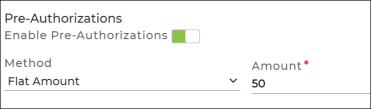
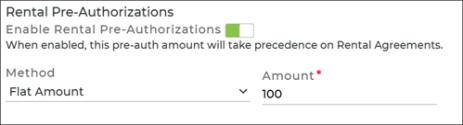
- (Optional.) Turn on pre-authorizations (for all agreements and/or just Rentals). Set your location up to take pre-authorizations against the captured credit card via the Credit Card Capture Required at Open and Pre-Authorization Settings management setting. Read more:
Pre-authorizations reserve (hold) funds on a customer's credit card, so it can be used for payment at close agreement (or released, if not used). To learn more about how pre-authorizations actually work on agreements, see "Pre-Authorizations".
Example: Let's say you have your location set to pre-authorize $50 over the cost of the bill. If an open agreement accrues $100 in charges and fees, $150 would be pre-authorized (the total due + $50) against the customer's credit card.
Depending on your Agreement Types and integration, you can configure the following:
- (For Stripe) Pair your card readers, if applicable. Once your Stripe account is set up and you’ve received your hardware, you must pair your devices in the mobile app, so they can be used during the agreement process on mobile devices. See "Pair BBPOS Reader".
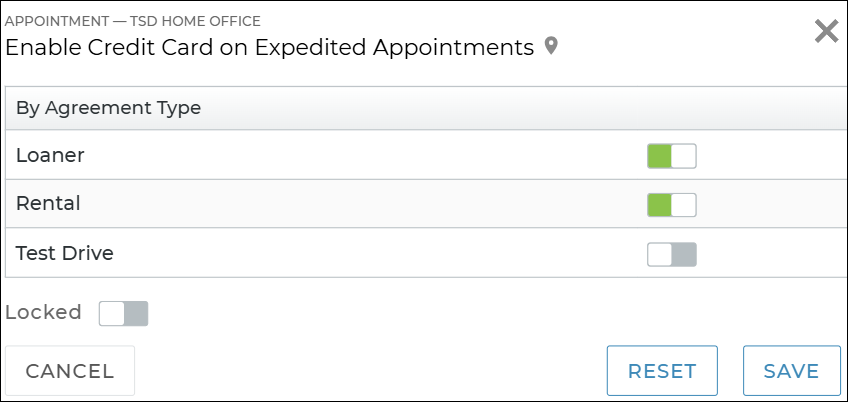
- (Optional.) Turn off credit card capture on expedited appointments. For locations with Expedited Appointments, the Enable Credit Cards on Expedited Appointments setting is turned on, by default, for your appointment types, so the customer can submit a credit card for future payment. You can choose to turn off this setting for one or more appointment types, so the Credit Card Details and Enter Credit Card button are not present.
Hover to view the full-sized image.
Credit Card Capture
Capturing a credit card on an appointment or agreement is the first step to charging. (You can only take payments at close.)
The card capture occurs within an iFrame: a secure, embedded dialog on which all cards on file are assigned a ‘token,’ or a unique code that replaces sensitive PCI card data.
After a credit card is captured, you can choose to pre-authorize the card to hold funds for charges (if your location is configured to do so), save the card to the customer's profile for future agreements, and bill for toll / violation charges, depending on your exact integration.
Capture a credit card on TSD DEALER web
Capture a credit card on the appointment or agreement, so it is on file for potential charges. (You can only take payments at close.)
The card capture occurs within an iFrame: a secure, embedded dialog on which all cards on file are assigned a ‘token,’ or a unique code that replaces sensitive PCI card data.
- On the appointment or agreement, click CAPTURE CREDIT CARD,
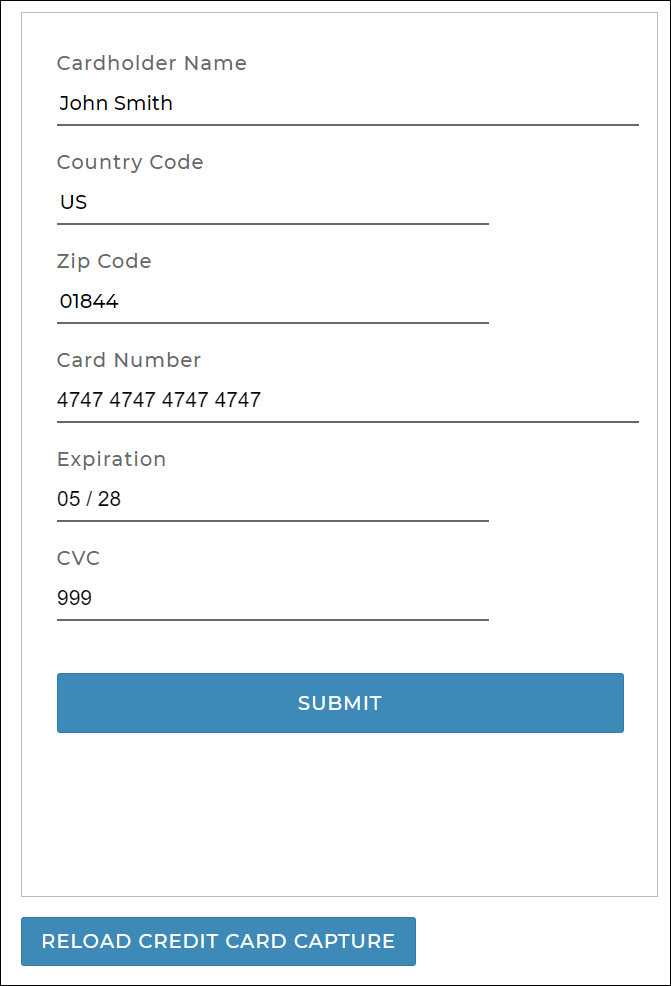
- In the credit card capture iFrame, enter the required billing information.
Note: The iFrame and required fields may differ, depending on your credit card provider. The name and address may be filled in from the appointment or agreement, if present. If you need to reload this iFrame, click RELOAD CREDIT CARD CAPTURE.
- Click SUBMIT.
Hover to view the full-sized image.
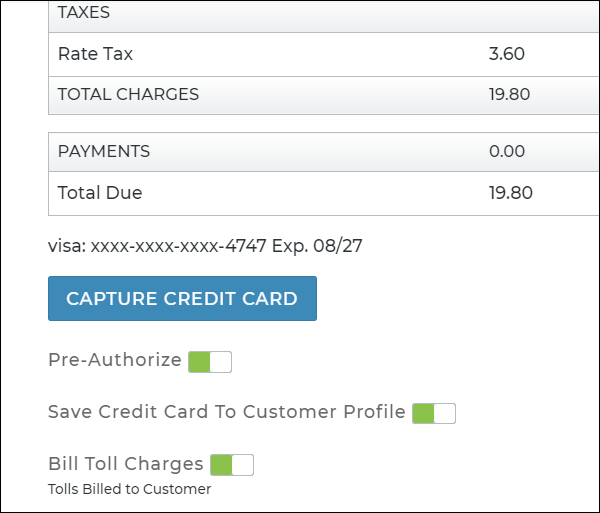
- If successful, a token is generated for the credit card and the card is added to the agreement, replacing any previous card associated with the agreement. Key card information (card type, last four digits, and expiration date) is displayed (e.g., visa: xxxx-xxxx-xxxx-4747 Exp. 05/28).
Hover to view the full-sized image.
Hover to view the full-sized image.
Credit card captures are logged in the agreement history (Credit Card), accessible via the History button on the side panel of an agreement.
- Now that a credit card is captured on the agreement, you may have several other options, depending on your integration and employee role's permissions.
- Have a pre-authorization automatically taken against the card for charges.
- Save the card to the customer's record for future appointments and agreements.
- Bill the card for any future toll / violation charges incurred on the agreement.
Capture a credit card on the TSD DEALER mobile app
With the mobile app, you can capture a credit card on agreement by manually entering card information or, if supported by your credit card provider, a supported mobile card reader. See "Supported Devices and Peripherals" for more information about supported devices.
Note: The default method of credit card entry (manual or device) is based on your mobile settings ( ).
).
- On the agreement, choose whether you want to manually enter a card, or use a supported card reader.
- Manually enter a credit card:
- Tap Enter Card.
- In the credit card capture iFrame, enter the required billing information.
- Tap SUBMIT. If successful, a token is generated for the credit card and the card is added to the agreement, replacing any previous card associated with the agreement. Key card information (card type, last four digits, and expiration date) is displayed (e.g., visa: xxxx-xxxx-xxxx-4747 Exp. 05/28).
- (CenPOS) Capture a card using an ingenico ICMP mobile card reader:
- Tap CAPTURE CARD to open the processor's mobile app.
- In the app, tap the card icon in the upper-right corner to activate the iCMP device. Your mobile device displays the message, "Waiting for card."
- Insert or swipe the card into the device.
- Tap Submit.
Can't see the Submit button? Try hiding the on-screen keyboard by tapping above it or pressing the down arrow below the keyboard.)
- Confirm the amount by pressing the green button on the iCMP device.
- Follow any additional on-screen instructions that are displayed on the iCMP device, if applicable.
- After the card has been processed, transaction information is displayed.
- Tap Done. If successful, a token is generated for the credit card and the card is added to the agreement, replacing any previous card associated with the agreement. Key card information (card type, last four digits, and expiration date) is displayed (e.g., visa: xxxx-xxxx-xxxx-4747 Exp. 05/28).
- (Stripe) Capture a card using a mobile card reader.
- Tap Enter Card.
- Insert or swipe the card into the device.
- After the device beeps and prompts you to remove the card, remove the card.
- The card capture process is complete. If successful, a token is generated for the credit card and the card is added to the agreement, replacing any previous card associated with the agreement. Key card information (card type, last four digits, and expiration date) is displayed (e.g., visa: xxxx-xxxx-xxxx-4747 Exp. 05/28).
- Now that a credit card is captured on the agreement, you may have several other options, depending on your integration and employee role's permissions:
- Have a pre-authorization automatically taken against the card for charges (at save, if opening a new agreement, or at the time the card is captured, if viewing an agreement). Toggle on Pre-Authorize.
- Save this credit card to the customer's record for future appointments and agreements. Toggle on Save Credit Card to Customer Profile.
- Bill the credit card for any future toll charges incurred on the agreement. Toggle on Charge Violations to Customer.
Bill for tolls / violations
Locations that use Credit Card Processing for toll / violation charges can choose to have the customer's credit card automatically billed for any tolls / violations incurred on the agreement. You can do this up until the agreement is closed. See "TSD Toll Connect: Toll Processing" for more information.
- Make sure you've captured a credit card on the agreement. See "Credit Card Capture". If capturing a new card, you can choose whether to have the card pre-authorized, at save, via the Pre-Authorize toggle. See "Pre-Authorizations" for more information.
- Choose who is responsible for toll / violation charges: the customer or your location. If your location is set up for Toll Processing, you can toggle on Bill Violation Charges to charge tolls / violations to the customer's credit card, or leave it toggled off to have them billed to your location. See "TSD Toll Connect: Toll Processing" for more information.
- Continue your agreement process.
Pre-Authorizations
Pre-authorizations are only available if configured within the Credit Card Capture Required at Open and Pre-Authorizations Settings management setting.
A pre-authorization is a temporary hold placed by a credit card merchant on a customer's card to reserve funds for future payment.
As part of your integration, you can set up your location to have a pre-authorization of a configured amount automatically taken against the captured card. When opening a new agreement, the pre-authorization occurs at save; otherwise, it is taken at the time the card is captured.
Pre-authorization FAQs:
- What if I have a Rental-specific pre-authorization set up? Read more: The process of pre-authorizing is the same, but at open, or when viewing an open agreement, you can customize the amount on the agreement before pre-authorizing via the Edit Pre-Auth button, and you'll find your configured pre-authorization amount defaults displayed for easy reference.
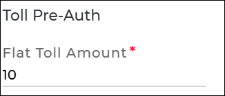
- What if I have a toll pre-authorization set up? Read more: If you use credit card processing for tolls / violations as well as for agreement charges, these pre-authorizations are taken separately, based on your setups.
- What happens if you change the credit card after a pre-authorization was already taken? Read more: After an agreement is opened, changing the credit card at any point before the agreement is closed will release (reverse) the previous unused pre-authorization taken for agreement charges. (If a toll pre-authorization was taken, it will "fall off" the card after a length of time, depending on the credit card merchant.) The new pre-authorization will be taken for main agreement charges and for future toll charges, if applicable.
- What if an attempted pre-authorization fails? Read more: If the pre-authorization attempted against the credit card is declined (e.g., no credit card on file, a failure submitting the transaction, a declined card), the application displays a Pre-Authorization error message, so you can collect another form of payment, if needed: "Failure trying to submit transaction for Credit Card Processing - [Error]." Note that, if a credit card is required on agreements at your location, you cannot open an agreement with a failed pre-authorization.
Pre-authorize a credit card on an agreement
- Turn on the Pre-Authorize toggle. Toggle on Pre-Authorize on the agreement, if not selected by default.
Important Note: When opening a new agreement, the pre-authorization is processed at save. However, if viewing / editing an agreement after open, the pre-authorization will be processed when a new credit card is captured. This means that, for Rentals, if you have a Rental pre-authorization set up, after you capture a card, the pre-authorization is already processed and you cannot edit the amount; the Edit Pre-Auth button is not displayed.
- (Rentals only, if applicable) Edit the pre-auth amount. If you have a Rental pre-authorization set up for Rental agreements and this is at open or editing an open agreement, you can click Edit Pre-Auth to customize the amount of the pre-authorization (anything over $1.00). You'll also find your configured Rental pre-authorization amount defaults displayed for easy reference. If you edit the amount, it will be updated.
Note: Note that this setting for rentals is currently only applicable when opening a new agreement, or viewing / editing an open agreement; it is not yet applicable at close agreement (the original pre-authorization setting will be used, at close).
- Make sure you've captured a credit card on the agreement. Capture a credit card to be pre-authorized. See "Credit Card Capture".

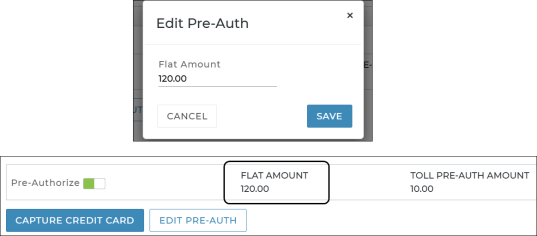
- The pre-authorization is processed automatically. This occurs at save, if opening an agreement, or after the card is captured, if the agreement has already been opened.
The total pre-authorized amount is displayed next to the card details. This amount includes both the main pre-authorization for agreement charges (i.e., rates, fuel charges, fees, and taxes), as well as the secondary pre-authorization for toll charges, if applicable.
After successful pre-authorization:
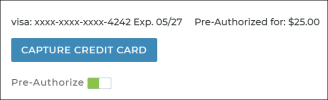
After successful pre-authorization, Rentals only (if a Rental Pre-Authorization is set up):

Payments (At Close Agreement)
Payment Restrictions:
- Payments can only be taken at close agreement, or after close (for newly-added fees only).
- You cannot manually take payments if you only use the integration for tolls / violations; in this case, payments are automated as tolls are incurred. See "TSD Toll Connect: Toll Processing" for more information.
- In order to process a payment, the Total Due for the customer must exceed $0.49, due to a $0.50 transaction fee on the location side.
You can process a payment against a captured credit card at close agreement, or after an agreement is closed (for newly-added fees only).
The payment will automatically use pre-authorization funds taken, if applicable, up to the amount due.
Take a payment at close agreement
- Begin the close agreement process. Review charges, as needed.
- Make sure you've captured a credit card on the agreement. See "Credit Card Capture". If capturing a new card, you can choose whether to have the card pre-authorized, at save, via the Pre-Authorize toggle. See "Pre-Authorizations" for more information.
- Choose who is responsible for toll / violation charges: the customer or your location. If your location is set up for Toll Processing, you can toggle on Bill Violation Charges to charge tolls / violations to the customer's credit card, or leave it toggled off to have them billed to your location. See "TSD Toll Connect: Toll Processing" for more information.
- Confirm the payment amount. Click PAYMENT. On the Submit a Payment dialog, adjust the payment amount, if necessary (the amount owed by the customer, by default).
- Process the payment. Click PROCESS PAYMENT. If the card was pre-authorized, the payment will use that pre-authorization. Otherwise, the payment will be charged to the card directly. The Total Due is updated to 0.00, and a Payments row is added to the Charges grid.
- Complete your close agreement process.
Pre-Authorization Scenarios:
Depending on the amount pre-authorized, the type of pre-authorization (i.e., agreement charges or tolls), and the amount due, there may be several different scenarios:
- If the pre-authorization was more than the amount due: Any remaining unused pre-authorization funds will "fall off" the credit card after a certain amount of time, depending on the individual credit card merchant.
- If the pre-authorization wasn't enough to cover the amount due: Any remaining amount due not covered will be processed against the credit card as a direct payment.
- If there are no charges: The system automatically releases (reverses) the entire unused pre-authorization. This is known in credit card processing terminology as a "reversal". The length of time a pre-authorization is held on a card depends on the individual credit card merchant.
An Accounting Transactions event is logged in the agreement's History when an unused pre-authorization is released by TSD DEALER. See "Agreement History (Event Logging)" for a list of events logged in a record's history.
View payment and refund transactions on a closed agreement
When viewing a closed agreement, a Payments grid is available with transaction details, including type of transaction (e.g., payment or refund), date, card information, and amount paid or refunded.
In the Payments grid, you can print or email receipts for payments and issue refunds, if necessary.
Refund a payment
If you need to issue a refund for a payment, you can do so when viewing a closed agreement, as long as a full refund hasn't already been issued for that payment.
- View the closed agreement.
- In the Payments grid, click REFUND next to the payment.
- On the Refund dialog, adjust the Refund Amount, as needed, and click OK.
- The Payments grid is updated with the refund (negative payment) record.
Print or email an invoice
After an agreement is closed, you can generate an invoice as formal request to the customer or billing company (for split invoices) of charges due for payment.
- View the closed agreement.
- In the Charges section, click PRINT INVOICE or EMAIL INVOICE.
- If this is a split invoice, select the customer or company invoice, or choose Print All / Email All to print / email each invoice on its own page.
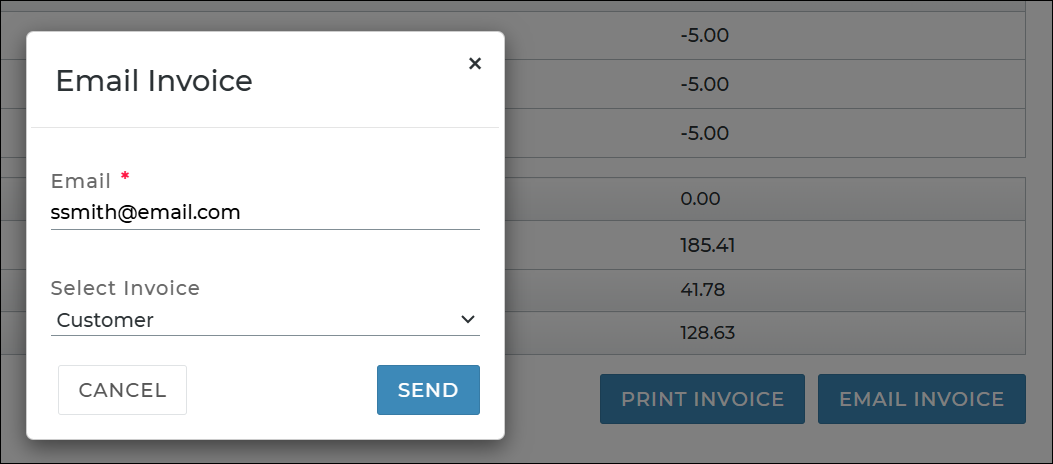
- If emailing, verify the email address, if different than the one used on the agreement.
- Click PRINT (if printing) or SEND (if emailing).
Hover to view the full-sized image.
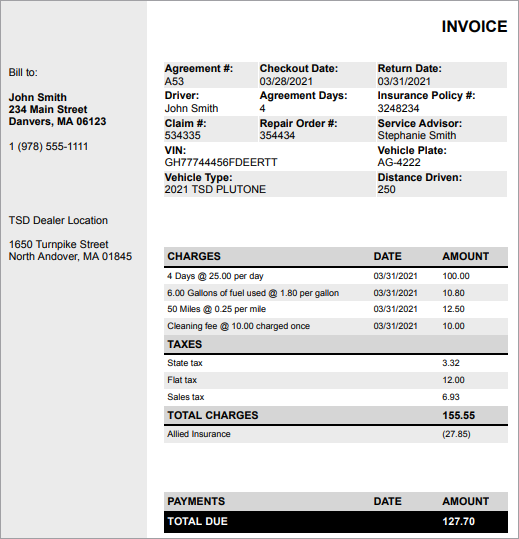
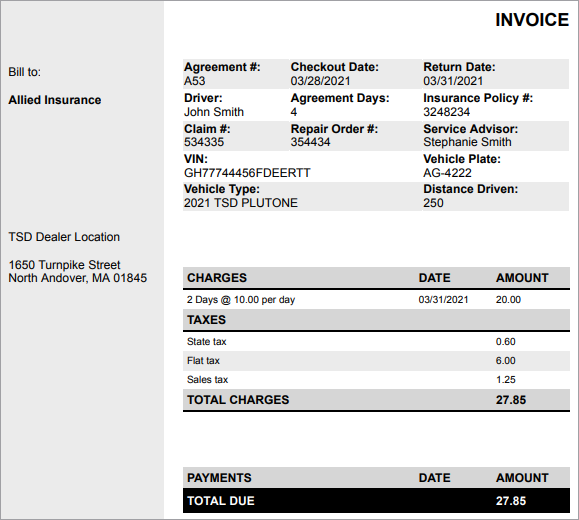
An invoice includes the following information:
- Important agreement and driver information, including Agreement Number, Checkout Date, Return Date, Driver, and Agreement Days.
- Repair and insurance information, including Insurance Policy #, Repair Order #, Service Advisor, and Claim #, if an invoice was split between a customer and company and a Claim Number was added.
- Most recently-assigned unit information, including VIN, plate, year, make, model, and distance driven.
- (Customer invoice only) All rate, fuel, mileage, and fee charges applied to the entire agreement's bill and the dates the charges were applied.
- (Company invoice, on a split invoice) Charges billed to a company and the dates the charges were applied.
- A line for customer write offs, where the customer invoice will contain the actual amount written off the bill.
- Taxes applied to the entire agreement's bill (on a customer invoice) or taxes on the company's portion of rate charges (on a company invoice). Note that, on a customer invoice, a company may be responsible for some rate charges and taxes on its portion of the charges; the total amount covered by the billing company is subtracted from the total charges due from the customer, as shown on the customer's invoice.
- Total charges, equaling the sum of charges and taxes billed to the customer (on a customer invoice) or to the company (on a company invoice).
- (Locations with credit card processing) Key card information for the card on which a payment was processed.
|
Sample customer invoice
|
Sample company invoice
|
Print or email a receipt for payments
After payment is received or a refund is issued, you can print or email a receipt as proof of purchase for the customer.
- View the closed agreement.
- In the Payments grid (for agreement charges) or Toll Violations section (for toll / violation charges), click PRINT to print a PDF, or Email to email.
- For emailing, verify the email address, if different from the one used on the agreement, and click SEND .
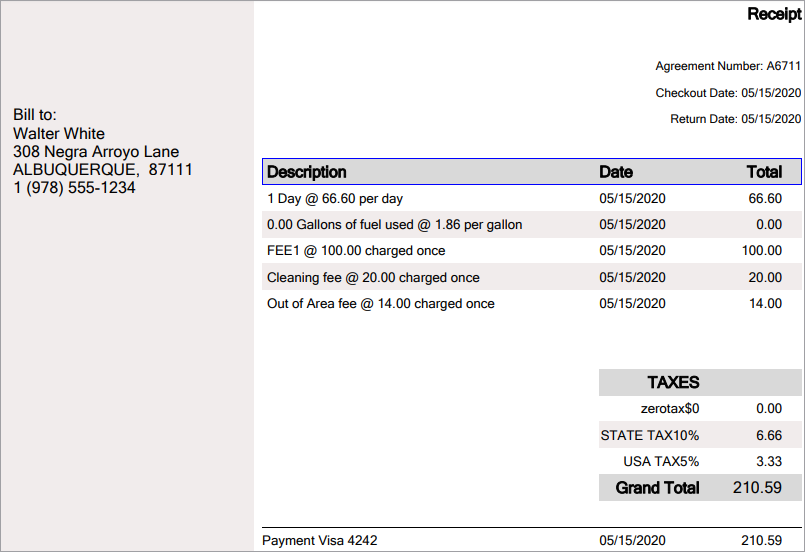
The receipt includes a description and amount of all rates, fuel charges, mileage charges, fees, and taxes on the agreement, the dates on which the charges were applied, and key card information for the credit card on which a payment or refund was processed.
Hover to view the full-sized image.
Frequently Asked Questions
When can I process a payment against a card?
You can capture a credit card anytime during the agreement process, but you can only process a payment:
- during the close agreement process or Quick Return.
- after the agreement is closed, for any newly-added fees.
With Toll Processing, how does TSD determine the correct charge?
When a toll violation is received, TSD DEALER matches the date and time of the toll violation to the agreement's date range for the unit, based on the transponder ID, if available, or the license plate and state, in order to identify the correct agreement & customer to be charged.
- The customer's card on file is billed if: a match is found and Bill Violation Charges (Charge Violations to Customer on mobile) was selected on the agreement.
- The dealership's card is billed if:
- a matching agreement is found and Bill Violation Charges or Charge Violations to Customer was cleared.
- no matching agreement is found.
- the customer's card was charged, but the card was not present or results in a declined charge.
- the agreement was an Internal Use agreement.
Best Practices
The following are tips and recommendations when using Credit Card and Payment Processing. See "Best Practices: TSD Connect (Credit Card Processing for Rates, Fuel and Tolls)" for more information.
Fill in required credit card information fields. When capturing a credit card, the First Name, Last Name, Country, Address, City/Town, State, Card Number, Expiration (MM/YY), CVC and Zip Code are all required. (When Toll Processing is also enabled, the customer's email address is required to save a customer record, appointment, and agreement.)
Keep customers informed. You, the merchant, must disclose initial pre-authorized and charged amounts and fees to cardholders.
If a card is declined, do not attempt additional charges. Doing so will flag the processor and you may incur increased processing fees. Additionally, these repeated attempts to authorize a declined card may create bank-initiated chargebacks. Refer to the card issuers' websites for recommendations on avoiding chargebacks.
Additional charges on the same card may be taken automatically on the same agreement for toll charges. With toll processing, the customer's credit card is charged for any toll charges incurred on the agreement, ten (10) days after the agreement is closed. Additional charges on the same card may be taken automatically on the same agreement for any additional tolls, as applicable.